
When people talk about a “welding electrode factories”, someone still imagines a small workshop full of smoke and manual work.
But, this image is already outdated.
Around the world, modern electrode factories have become high-tech welding material manufacturing centers.
What Do Welding Electrode Factories Produce?
Welding electrode factories produce welding consumables.
The most common product is the covered welding electrode.
A standard welding electrode has two main parts:
* **Metal core wire**
* **Flux coating**, made of mineral powders, ferroalloy powders, and deoxidizers
Based on application needs, factories usually produce:
* Carbon steel electrodes (such as E6013, E7018)
* Low hydrogen electrodes
* Stainless steel electrodes
* Wear-resistant electrodes
* Special alloy electrodes
Among all products, carbon steel electrodes and low hydrogen electrodes remain the core of the global welding electrode market.
Who Buys Welding Electrodes?
Big Changes in Downstream Industries
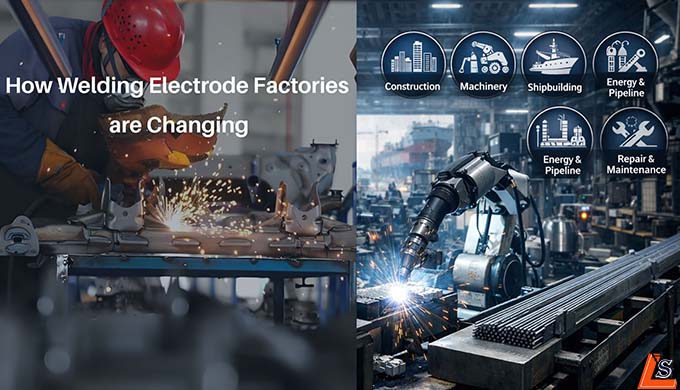
Welding electrodes serve some of the world’s largest industries.
1. Construction and Steel Structure
Used for bridges, buildings, plants, and steel structures.
These users focus on stable welding and high work efficiency.
2. Machinery and Equipment Manufacturing
Including construction machines, mining equipment, and farm machines.
They require strong welds and consistent quality.
3. Shipbuilding and Marine Engineering
Heavy plates and large welding volume.
Low hydrogen electrodes and stable arc performance are critical.
4. Energy and Pipeline Industry
Oil, gas, power plants, and pressure vessels.
These industries are extremely sensitive to welding defects.
5. Repair and Maintenance Market
A long-term and stable consumption market.
Users care about easy welding, stability, and no rework.
How Do Downstream Industries Change Welding Electrode Factories?
Global manufacturing is upgrading fast.
Downstream industries now show clear new trends:
* Stricter standards and certifications
* More automated and semi-automated welding
* Higher demand for weld consistency
* Lower tolerance for defects and rework
In the past, customers mainly asked about price.
Today, they ask different questions:
* Is performance stable between batches?
* Can it work well in continuous production?
* Is it suitable for automated welding lines?
* Can it reduce overall welding risk?
Because of this, electrode factories are shifting from experience-based production to stability-driven manufacturing.
Key Adjustments Welding Electrode Factories Must Make
Under downstream pressure, factories focus more on:
* Raw material stability
* Controlled flux coating systems
* Compatibility with automated production
* Batch-to-batch consistency
This pressure forces factories to rethink, their formulas and production processes.
So how do welding electrode factories respond to these challenges?
And on the raw material side, which materials play a critical stabilizing role?
That is the next question the industry must answer.